9/13/09

Debtor's Revolt

Yves Smith of Naked Capitalism wants to stick it to the Man. Or at least that is what she says in A Shot Across the Bow (Debtors’ Revolt Watch). In the post, an embedded YouTube video by Rockerchic4God (aka Ann Minch) urges the audience to default on their credit card debt en masse, to protest unjustified rate hikes of up to 30% APR.


Let me make this clear, I believe that Minch is sincere and should be commended for attempting to stand up to an out-of-control, predatory industry. Unfortunately, her plan is fatally flawed due to the Federal Reserve subsidized securitization of revolving credit via the TALF program. TALF is essentially the bastard child of Geithner's PPIP concept, where retail debt is securitized and the Federal Reserve Bank of NY makes low interest, non-recourse loans for near 90-95% of the face value of the securitization to interested buyers. The buyer then pledges the newly purchased and likely overvalued securities as collateral for the loan. TALF has been accepting credit card debt since May and has potentially put the taxpayer on the hook for around $20.1 billion.
If any sort of organized default activity were to occur, the credit card companies would simply pile more debt into the TALF dumpster (The minimum loan amount is $10M and there is no maximum.) While I don't expect Ann Minch to know any of this, I find it difficult to believe that Smith is unaware of this. After all, she is an eminently qualified financial expert, just ask her:
Although I believe ideas should stand on their own merit, rather than on their author's credentials, I also recognize that readers want some assurance that they are not quoting a 13 year old or a dog. I have undergraduate and graduate degrees from Harvard. I have been working in and around the financial services industry since 1980 and have had over 40 articles published in venues such as The New York Times, Institutional Investor, The Daily Deal, U.S. Banker, Bank Mergers & Acquisitions, The Conference Board Magazine, BRW Magazine (Australia), and Boss Magazine (Australian Financial Review).

What Smith fails to mention in her bio is that she is also the President of Aurora Advisors, which is a financial management consulting firm serving Wall Street. Smith knows damn well that credit card lenders like JP Morgan Chase, Citigroup, and Bank of America (aka her potential and, perhaps, current clients) wouldn't be significantly impaired by Minch's debtor's revolt. The participants who would be harmed are the taxpayers, as usual, and the debtors. To be fair, Smith gives a half-assed warning about trashing your credit and statutes of limitations on the claims of creditors, but since she didn't look into the actual consequences to the debtor, it's fairly clear that's not where her sympathies lie.

In reality, if you walk away from a credit card debt, your account will go into collections after 30 days and your FICO score will be reduced dramatically. This may very will trigger drastic interest rate increases on your other cards. Eventually, the account will be sold at a deep discount to a collections agency that will harass you for payment for several months. Once they give up, they'll resort to legal means. You will be sued in civil court and if you fail to show up, a default judgement will be issued for the debt and the collector's legal fees and wage and asset garnishment will likely occur. If you insist on a trial, you won't have a leg to stand on, so the results will likely be the same, plus your legal fees. Don't underestimate the capacity of the civil courts, either. Every debt court that I've observed was a well-oiled machine in which default judgements were rendered at the pace of a standard auction.

Employers hate garnishment orders of any sort and view them as grounds for refusing employment. If you're already employed, they can't legally fire you for the garnishment resulting from a debt, but they can always manufacture another reason. In the video clip, Minch states that she is aware of the consequences, is
judgement proof, and is willing to take the heat. From what I observed in the 4:28 minute clip, under no circumstances would I screw with Minch without the benefit of a concealed straight-razor and a good pair of track shoes. For the rest of us, this strategy probably makes sense only if you are planning on filing for bankruptcy and can pass the means test for debt discharge (Ch.7 vs Ch.13).

Is Smith hopelessly naive or is she shilling for the Man? I really don't know. Everybody is here for a reason (including myself) and I doubt it's bloggers who are punching Smith's meal ticket. In fact, in Smith's position, writing a blog critical of Wall Street would appear to be one of the dumber things she could do. Is it possible that the adoration of anonymous strangers is worth risking your livelihood for? Who knows? T
he take away here is that it hasn't gotten any wiser to allow others to critically think for you.

9/9/09

Jobless Recovery and the Newest Normal

If you are fortunate enough to be employed, I encourage you to take a long look at your last paystub. While it may be less than it was a year ago, what you see is still noteworthy, as it likely represents the most compensation that you will receive for a very long time. Welcome to the New Normal.

I'm certain that you've heard that consumer spending is responsible for 70% of the US GDP, ad nauseam. This figure is mostly worthless, without delving into the components of the consumer spending and earning. Zero Hedge had an excellent post titled, A Detailed Look At The Stratified U.S. Consumer, in which the debt levels and consumption patterns of the social classes are examined in detail. What ZH determined was that upper 10% held a disproportionate amount of disposable income relative to the middle and lower classes, which is made abundantly clear by the following ZH graphic:
Source: ZeroHedge
Thus, it was determined that the richest 10% accounted for 42% of consumption, the middle class (40%-90% net worth) accounted for 48% of consumption and lower class (0-40% net worth) were only responsible for only 12% of consumer spending:
Source: ZeroHedgeRelatively speaking, the spending of the upper, middle, and lower class is 3.5:4:1, respectively. Thus, from the perspective of Wall Street, the lower class has few redeeming qualities and in fact poses more of a liability, due to the fact that consumers are also workers. Since the lower class can't add substantially to the left side of the balance sheet, it stands to reason that their right side influence should be reduced. Obviously, this can be accomplished via outsourcing, but this is rarely as profitable as advertised, due to shipping and complications that arise from operating in the third world.

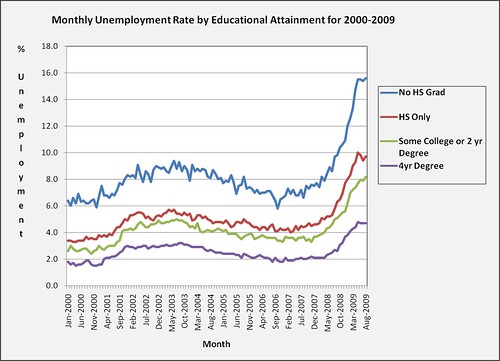
So, how can the third world be brought here? Immigration laws can go unenforced to maintain wage floors that are unlivable for legal workers. The threat of outsourcing and the reduction of workers' rights can be used to defeat any attempt at worker organization. All of this has been done flawlessly. Real wages in this country have stagnated over the last decade, regardless of what part of the boom/bust cycle we were in. However, the perfection of this scenario requires stratified, permanently high unemployment. If high unemployment can be maintained amongst the working class and moderate unemployment in the middle class, the employer take backs will be tremendous. Can it be done? I have every confidence:


Source: BLS, Datasets LNS14027659, LNS14027660, LNS14027689, and LNS14027662.

8/30/09

Maryland Bank Capitalization Data: 6/30/09 FDIC Call Report Data

On Thursday, the FDIC released the 6/30/09 Call Reports for the banks that it supervises.Below you'll find capitalization data for for all banks headquartered in Maryland for this period. Note that Bradford Bank failed on Friday, 8/28/09, but I've included their numbers for reference.

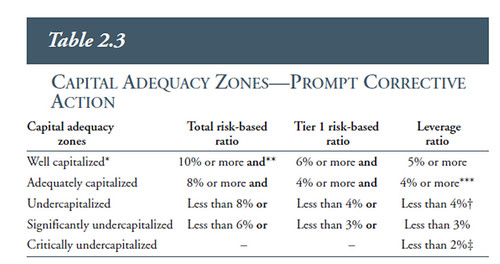
The FDIC evaluates capitalization ratios as follows:

However, in light of the fact that many of the recently failed banks could be considered adequately capitalized, these standards are of increasingly questionable utility. Nevertheless, the relevant ratio definitions are provided below:
1. Bank equity capital- Total bank equity capital (includes preferred and common stock, surplus and undivided profits).
2. Equity capital to assets (eqv)- Total equity capital as a percent of total assets.
3. Texas Ratio (TR)- (Non-performing assets+REO)/(Equity-Intangibles-Goodwill+Loan Loss Reserves). Note: Not an FDIC ratio, but the only metric provided that accounts for non-performing assets.
4. Tier one (core) capital- Tier 1 (core) capital includes: common equity plus noncumulative perpetual preferred stock plus minority interests in consolidated subsidiaries less goodwill and other ineligible intangible assets. The amount of eligible intangibles (including mortgage servicing rights) included in core capital is limited in accordance with supervisory capital regulations.
5. Core capital (leverage) ratio (rbc1aaj)- Tier 1 (core) capital as a percent of average total assets minus ineligible intangibles.
6. Total risk-based capital ratio (rbcrwaj)- Total risk based capital as a percent of risk-weighted assets as defined by the appropriate federal regulator for prompt corrective action during that time period.
7. Tier 1 risk-based capital ratio (rbc1rwaj)- Tier 1 (core) capital as a percent of risk-weighted assets as defined by the appropriate federal regulator for prompt corrective action during that time period.

Several loan performance metrics were included, which aren't used by the FDIC to assess capital adequacy, to give a handle on the impact of loan defaults on future income and are defined as follows:
8. Noncurrent assets plus other real estate owned to assets (nperfv)- Noncurrent assets as a percent of total assets. Noncurrent assets are defined as assets that are past due 90 days or more plus assets placed in nonaccrual status plus other real estate owned (excluding direct and indirect investments in real estate).
9.Noncurrent loans to loans (nclnlsr)- Total noncurrent loans and leases, Loans and leases 90 days or more past due plus loans in nonaccrual status, as a percent of gross loans and leases.
10.Net charge-offs to loans (ntlnlsr)-Gross loan and lease financing receivable charge-offs, less gross recoveries, (annualized) as a percent of average total loans and lease financing receivables.


Maryland Bank Capitalization Data: 6/30/09 FDIC Call Report Data

8/28/09

They Must Have Missed Bernanke's Memo

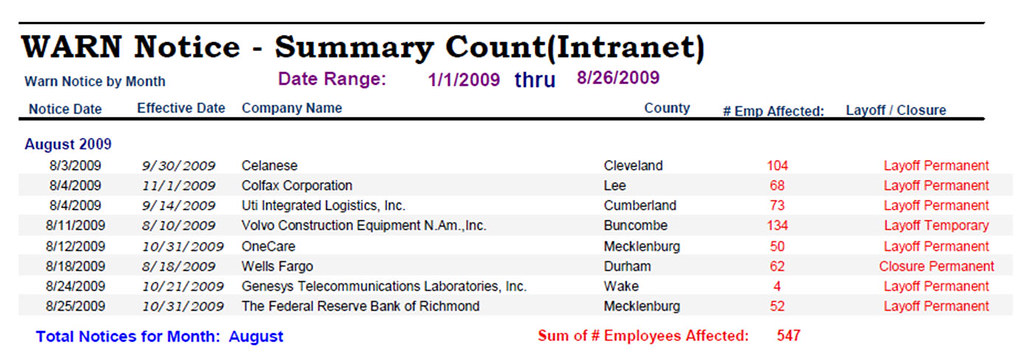
You'd think that Federal Reserve Bank would lay off of layoffs while their Chairman is campaigning for the position of Savior of Everything. Not so much:


Source: North Carolina Dept. of Commerce WARN

8/14/09

Grandpa's Green Shoots

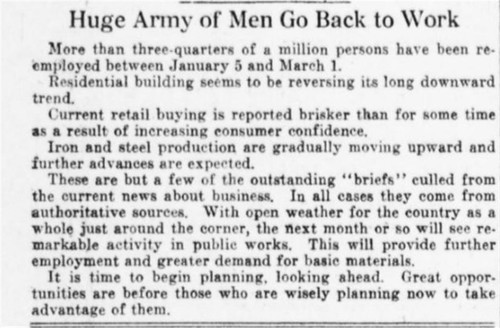
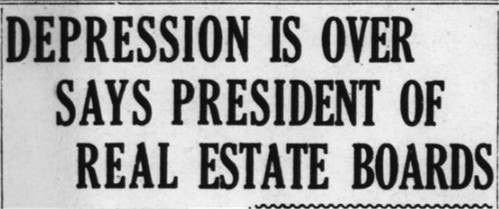
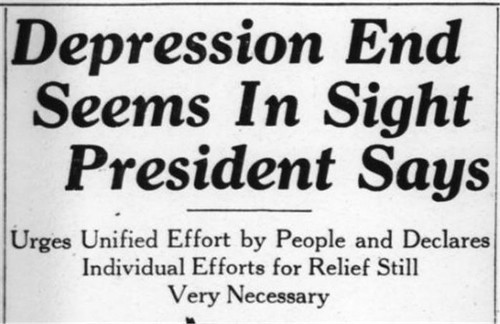
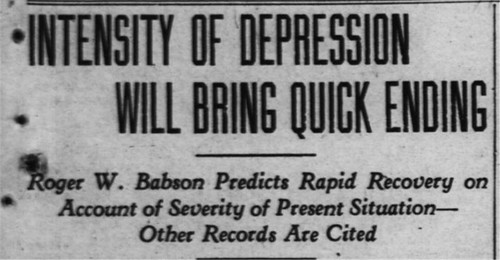
Google has added the ability to search and retrieve certain scanned newspaper articles to its news timeline search feature, although the selection of newspapers is currently rather limited. Below are some of the Green Shoots that your grandparents had to contend with.

1. St. Petersburg, FL: 10/07/1932, The Evening Independent


2. Spokane, WA: 3/12/1931, Spokane Chronicle:


3. St. Petersburg, FL: 01/13/31, The Evening Independent:


4. St. Petersburg, FL: 09/28/1934, The Evening Independent:


5.
St. Petersburg, FL: 11/06/31: The Evening Independent


8/9/09

AIG Chicanery of 8/5/09

On Friday, August 7th, AIG reported a return to profitability for Q2 2009 with an EPS of $2.30, following six successive quarters of loss. In a Friday press release, AIG attributed the positive earnings to a combination of the revaluation of assets due to accounting rule changes and agreements with the Federal Bank of NY to exchange debt for preferred shares in business units (ALICO/AIA) that are earmarked for future sale.

Common shares of AIG closed at $27.14 on Friday, for a gain of $4.61 or 20.5%. Personally, I have my suspicions regarding the validity of AIG's claims, but I'm in no position to make an educated assessment, as I have not delved deeply into their financial statements and have no intention of doing so. I don't trade AIG and until recently I excluded major TARP recipients from my trading radar, as a matter of course. If investors want to take AIG at its word, it's their prerogative.

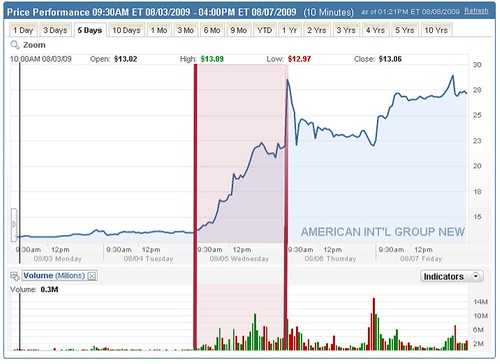
What I do have a serious problem with is the events of Wednesday, August 5. On Wednesday, AIG opened at $13.64 and rocketed to a close of $22, constituting a one day gain of 62%. The stock's volume was 134M shares compared to 7.9M on the previous day representing a 17x increase, as indicated in the following chart (red emphasis is mine):

On Monday, 8/3, it was reported that Robert Benmosche was elected as the new CEO, but the stock showed little response. On Wednesday, 8/5, there was no news regarding AIG, nor were there any SEC filings. In fact, the most informative story on 8/5 was by the WSJ, titled: Why Is AIG Stock Up 63% Today? , in which the WSJ provided all sorts of implausible excuses for the runup. At least the WSJ acknowledged the runup, most business media ignored AIG stocks's second largest daily move in the last 25 years.

While the prospect of a one day gain of 62% sounds lucrative, it's not. Relatively speaking, it's chump change compared to the returns provided by the derivatives markets (relative return rates are above each bar):

Thus, if at 9:15AM on 8/5/09 you were holding 100 AIG HW August 25 calls, your position would be worth $600. Seven hours later, that same position could have been closed for $25,400 for a return of 4,133% and with the judicious use of trailing stops the return could have been closer to day's high of $3.00. This is the equivalent of dunking on Shaquille O'Neal, checkmating Gary Kasparov, and sleeping with God's wife, all in the same day. In other words, it can't happen. Yet, judging by the heavy options volume on 8/5, it very much did. I'm curious as to who made those OTM long call trades early on 8/5 and why we haven't heard from those who took the other side.

At the risk of appearing hyperventilatory, I believe that Occam's razor is readily applicable: AIG's 62% price runup on 8/5 can be attributed to the dissemination and systematic exploitation of insider information. The 1596% increase in volume clearly indicates that this can only involve large, institutional investors and that they are sufficiently secure in the SEC's impotence and the public's ignorance to make such a brazen move. Some might ask: Where are the cops? There aren't any and this is precisely the point that I'm trying to make. If you are trading in these markets, be aware of how far the House is willing to go press its advantage it and plan accordingly.

8/3/09

Constellation Energy Group's New Math

Constellation Energy (CEG) reported its Q2 earnings on 7/30 in an 8-K statement that is provided below. They reported adjusted quarterly earnings of $1.08/share, which is 40% lower than its 2008 adjusted Q2 earnings of $1.82/share. Under normal circumstances, a 40% profit reduction would be cause for alarm, but in light of the prior year, it bolsters the company's claims that they are on the road to recovery.

Unless, of course, you insist on using accounting. If you're incapable of "outside the box" thinking and require the use of GAAP, then CEG's Q2 earnings were $0.04/share and constituted a 95% reduction in year-over-year profit.

On page 4 of the 8-K, Shattuck and the Enronettes justify this distorting earnings by 27 times ($1.08 vs $0.04) as follows:
We present adjusted EPS because we believe that it is appropriate for investors to consider results excluding these items in addition to our results in accordance with GAAP. We believe such a measure provides a picture of our results that is more comparable among periods, since it excludes the impact of items such as impairment losses, workforce reduction costs or gains and losses on the sale of assets, which may recur occasionally, but tend to be irregular as to timing, thereby distorting comparisons between periods. However, investors should note that this non-GAAP measure involves judgment by management (in particular, judgment as to what is classified as a special item to be excluded from adjusted earnings). This non-GAAP measure is also used to evaluate management’s performance and for compensation purposes.
(Emphasis is mine.)
In other words, the non-GAAP earnings omit non-recurring charges in order to provide a picture of "normal" operations. In Constellation's case, the exception is the rule and a quarter without extraordinary charges would be an anomaly. Clearly, these figures are used being used to justify senior management's looting of the treasury and to deceive unwary investors. .

On the other hand, perhaps I'm being narrow-minded with respect to Constellation's accounting practices. Since I have a current $128 Constellation electric bill in front of me, I can't think of a better opportunity to practice some of Shattuck's "outside the box" methodology. Thus, I see no reason not to submit $4.74, which is a 27 time reduction that represents, in the judgement of Shortbus management, a truer picture of my power consumption.

No positions in CEG.

CEG_8k_2Q09