6/28/09
And We're Back
I'm back to my evil ways. After a 4 month hiatus, I have resumed wildassed speculative trading, primarily in equity options. In February, I'd closed out my options account in an attempt to force myself to focus on more sustainable strategies, such as value investing in equities. However, the casino-like aspects of the current market seem entirely inappropriate for any kind of long term strategy. Thus, in May, I opened a new account with an options brokerage that also allows me to trade futures and future options. I doubt I'll get into futures and I can't begin to imagine how to price futures options, but it's nice to know that a house full of 40,000 lb of frozen hog bellies is only a few mouse mis-clicks away.


6/2/09
The Clueless Recovery
Here is a riddle for you, what is the difference between the following Lloyd Blankfein (GS CEO) quotes?
"Some of Wall Street's biggest names have been proclaiming in recent weeks that the worst of the financial market turmoil is likely done. JPMorgan Chase's Jamie Dimon thinks it is "maybe 75 percent to 80 percent over," while Goldman Sachs' Lloyd Blankfein says "we're closer to the end than the beginning."
"The end is already in sight, in the sense we're talking about it, and we have some confidence we will reverse out of (the downturn). And that is what I think is making the markets cheerier than they have been for while, and which has surprised people."
The difference would be about a year. The first quote is from a FOXNews article published on 4/22/2008, while the latter was is from 5/10/2009 Reuters article. Anyone who believed Blankfein in 2008, got their heads handed to them in September. Nevertheless, it appears that the investing public didn't learn much the OPEC called BS on the our pseudo-recovery in their May 2009 monthly report (bold type is mine):
Growth for the global economy in 2009 has been revised down further by 0.6 percentage points to now show a decline of 1.4%. The Euro-zone slipped deeper into recession; as a result the forecast has been revised down by 1.2 pp for a decline of 4.2%. Despite some positive signs, the US is still expected to decline at a rate of 2.8%, down 0.2 pp from the previous forecast. Growth expectations for China and India remain unchanged at 6.5% and 5.0% respectively. In general, it remains to be seen whether the current positive momentum is sustainable and whether the measures taken by central banks and governments will be enough to support an economic recovery.
Apparently, this is the only country where the banking stress test farce played well. The OPEC analysis of our financial system is surprisingly frank and bears no resemblance to the Green Shoot PR campaign being advertised in the US media (color is mine):
Despite those better-than-expected earnings in the banking sector, it remains to be seen whether these improvements in earnings are sustainable. Most of the earnings came from onetime actions like asset sales or accounting changes and/or potentially unsustainable trading income. Secondly, it has to be ensured that the need for new capital for the sector in general will not exceed the amount that is currently being considered appropriate. This has to be closely watched as well, as the accounting for asset-backed securities was recently changed in favour of US banks and there might be a danger that the values currently being reflected on the balance sheets might make further write-downs necessary. Thirdly it also remains to be seen whether the 19 banks of the SCAP are able to raise the amount of $75bn without any friction.
It is somewhat amusing that Green Shoot PR campaign can be debunked in one paragraph.. First, OPEC alludes to how AIG was used to backdoor the TARP process, by using CDSs to opaquely funnel money into the major investment banks. (I find it ironic that AIG CDS contracts were deemed sacred, while GM bond contracts are entirely negotiable.) Next, the silliness of letting banks test themselves and negotiate the results is questioned. Finally, the viability of the current pump and dump aspect of the Green Shoot campaign is doubted. Here, the analysts slip up due to their underestimation of the gullibility of the US public. Their concern regarding banks experiencing "friction" when raising new capital in the equities markets is unfounded--the American public has been lubricated more thoroughly than ever.
MR052009
6/1/09
The Geithner Comedy Tour
This week Treasury Secretary Geithner visited China in an attempt to restore confidence in the US financial system. China holds around $900B of US Treasury debt and has become increasingly alarmed with the Fed's policy of monetizing the debt. In Beijing, Geithner addressed a student audience at Peking University where he attempted to reassure the audience by stating, "Chinese assets are very safe." Per the UK Telegraph, "The comment provoked laughter from the audience of students."
I sincerely hoped the audience tipped Geithner at the end of his act. As you can see below, we need all the help that we can get.

I sincerely hoped the audience tipped Geithner at the end of his act. As you can see below, we need all the help that we can get.

5/27/09
Retardometrics
In a perfect world, we would all have numbers affixed to our foreheads providing an indicator of intelligence and lack thereof. Unfortunately, this is not only impractical, but would likely lead to discriminatory practices. Nevertheless, we have something known as The Consumer Confidence Index (CCI) which provides an aggregate public gullibility metric. Yesterday, The Conference Board reported May's CCI was 35% than that of April, indicating that the many of the 5000 households surveyed believed the government's Green Shoot PR campaign:

For certain, anyone within earshot of a teevee has heard the business media trumpeting the Green Shoot PR campaign. Any new economic indicator that is less negative is being proclaimed as positive and a confirmation that the recovery is at hand. (Considering all of the chicanery the government has condoned in the last six months, the accuracy of the most recent indicators is questionable.) The message is ubiquitous and apparently effective, demonstrating that the American public's appetite for propaganda is insatiable.
After all, didn't the teevee shill the following:
1. The Y2K non-apocalypse.
2. Electric deregulation
3. WMDs to justify the Iraq War.
4. 401k retirement plans in place of financial literacy.
5. The perpetual increase of housing prices and real estate speculation.
6. Consumption at the expense of saving.
7. Media consolidation
8. Diseases manufactured by the pharmaceutical industry, i.e. Restless Legs Syndrome.
9. A service economy based on truly unnecessary industries, instead of tangible good production.
10. Trade and immigration policies that led to a depressed standard of living in many parts of the country.
I would have thought that after seeing 40% of their retirement assets disappear, 30% of their home's value erode, 10% unemployment, an unprecedented $12T deficit, and the specter of massive tax increases, the public might start to question the MSM and whose interests it really serves. Apparently, the transient comfort provided by predatory optimism is preferable to reality. Thus, allow me to accomodate with the following inspirational excerpt from Time magazine titled, "Good Times Are Coming!," circa 2005:

For certain, anyone within earshot of a teevee has heard the business media trumpeting the Green Shoot PR campaign. Any new economic indicator that is less negative is being proclaimed as positive and a confirmation that the recovery is at hand. (Considering all of the chicanery the government has condoned in the last six months, the accuracy of the most recent indicators is questionable.) The message is ubiquitous and apparently effective, demonstrating that the American public's appetite for propaganda is insatiable.
After all, didn't the teevee shill the following:
1. The Y2K non-apocalypse.
2. Electric deregulation
3. WMDs to justify the Iraq War.
4. 401k retirement plans in place of financial literacy.
5. The perpetual increase of housing prices and real estate speculation.
6. Consumption at the expense of saving.
7. Media consolidation
8. Diseases manufactured by the pharmaceutical industry, i.e. Restless Legs Syndrome.
9. A service economy based on truly unnecessary industries, instead of tangible good production.
10. Trade and immigration policies that led to a depressed standard of living in many parts of the country.
I would have thought that after seeing 40% of their retirement assets disappear, 30% of their home's value erode, 10% unemployment, an unprecedented $12T deficit, and the specter of massive tax increases, the public might start to question the MSM and whose interests it really serves. Apparently, the transient comfort provided by predatory optimism is preferable to reality. Thus, allow me to accomodate with the following inspirational excerpt from Time magazine titled, "Good Times Are Coming!," circa 2005:
Do we really consume too much and save too little? Fed data show that while debt has been rising, so has net worth, and debt as a percentage of net worth does not look overstretched. I am not unmindful of the risks. But I do think most of the analysis wildly oversimplified, particularly when the problem is identified as "imbalances," as though the economic system's natural state had been perturbed and until returned to balance it was out of whack.
My point is simple: this is just one of the things people are worrying about while the broad economic picture could hardly be better. General Electric just reported strong earnings and is confident of double-digit growth. IBM did the same. Citigroup chief financial officer Sallie Krawchek said recently on CNBC that it was "credit nirvana," the best environment they had seen in almost 15 years, and Citigroup raised its dividend another 10%.
My point is simple: this is just one of the things people are worrying about while the broad economic picture could hardly be better. General Electric just reported strong earnings and is confident of double-digit growth. IBM did the same. Citigroup chief financial officer Sallie Krawchek said recently on CNBC that it was "credit nirvana," the best environment they had seen in almost 15 years, and Citigroup raised its dividend another 10%.
5/16/09
Catastrophe Cometh
On May 12th, the New York Times published a story regarding the effects in the recession on the state of Social Security and Medicare. Significant deterioration of the financial health of these entitlement programs has raised questions as to their future viability and the need for reform. The NYT provided the following disturbing graphic which illustrates exactly how dire the situation has become:
 As you can clearly see the future of Medicare and Social Security is very bleak. The Treasury's 2009 projections indicate that Medicare only has only 1.5 little rectangles remaining, while SS has experienced a 20% year-over-year little rectangle reduction. Compounding matters, the little rectangles are turning black, which is a classic economic indicator of
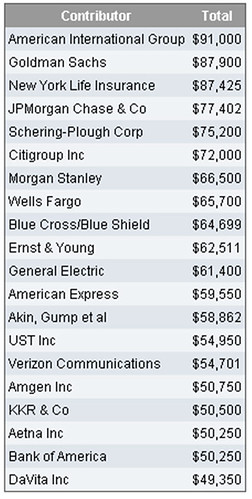
doom DOOM. The administration has proposed that health care cost cutting measures are the solution for Medicare:Austrian Polygonal Differential Analysis common sense on the following historical health care industry campaign contribution charts from OpenSecrets.org , the probability of future health care cost reductions fall somewhere in the range of notahopeinhell and 0.
 In reality, the health care and insurance industries are taking a page from the TARP playbook, where the specter of crisis.is being used to justify corrupt legislation. The health care lobby graciously agreed to reduce cost growth (not level, but rate of change) by 1.5%, yielding a projected savings of $2T over the next ten years. In exchange for this triviality, the insurance industry will receive a massive subsidy in the form of artificial demand creation; legally mandated health insurance for all US citizens in 2013.
This was the masterstroke of Senate Finance Committee's chairman, Max Baucus. Chairman Baucus spent long hours at the Roundtable to Discuss Reforming America’s Health Care Delivery System "hammering out" out the particulars with representatives from Blue Cross, Aetna, and the Business Roundtable. And when I say "hammering out," what I mean is selling legislation and the public interest for campaign contributions:
Lifetime contributions to Sen. Max Baucus via Opencecrets.org.

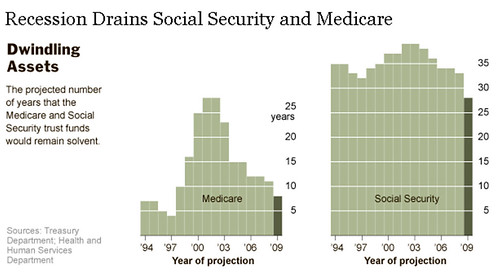 As you can clearly see the future of Medicare and Social Security is very bleak. The Treasury's 2009 projections indicate that Medicare only has only 1.5 little rectangles remaining, while SS has experienced a 20% year-over-year little rectangle reduction. Compounding matters, the little rectangles are turning black, which is a classic economic indicator of
The Treasury secretary, Timothy F. Geithner, said the only way to keep Medicare solvent was to “control runaway growth in both public and private health care expenditures.” And he said Mr. Obama intended to do that as part of his plan to guarantee access to health insurance for all Americans. But if cost controls do not produce the expected savings, Congress is likely to find it difficult to preserve benefits without increasing taxes.
Using  In reality, the health care and insurance industries are taking a page from the TARP playbook, where the specter of crisis.is being used to justify corrupt legislation. The health care lobby graciously agreed to reduce cost growth (not level, but rate of change) by 1.5%, yielding a projected savings of $2T over the next ten years. In exchange for this triviality, the insurance industry will receive a massive subsidy in the form of artificial demand creation; legally mandated health insurance for all US citizens in 2013.
This was the masterstroke of Senate Finance Committee's chairman, Max Baucus. Chairman Baucus spent long hours at the Roundtable to Discuss Reforming America’s Health Care Delivery System "hammering out" out the particulars with representatives from Blue Cross, Aetna, and the Business Roundtable. And when I say "hammering out," what I mean is selling legislation and the public interest for campaign contributions:
Lifetime contributions to Sen. Max Baucus via Opencecrets.org.
5/6/09
Thank You For Being A Friend
Yesterday, someone (who thinks this blog should be funnier??) sent me a link to The Bing Blog, which is the creation of, the aptly named, Stanley Bing. In Bing's most recent post, Things That Will Survive, he declares that the current recovery is genuine and prognosticates about what the new growth will look like. Since Stanley Bing isn't actually a real person and doesn't seem to have much economic training, he's more apt to be correct than your standard, celebrity econotard. I won't regurgitate his post, but it gave me an idea: Wouldn't it be clever to post a series of predictions, so that in a year I can look back and see that, I too, can't differentiate my ass from third base.
Prediction I: This rally is an extended sucker's rally. This isn't much of a stretch considering that 70% of the GDP is consumer based and somewhere between 10-15% of these consumers are now jobless. However, I am reminded of a time when I was all in on fairly out of the money puts. At the time, the government and the MSM were lying about the state of the economy, despite obvious evidence to the contrary. The experts called the bottom and proclaimed that up was the only direction remaining. I spent weeks mentally willing the destruction of the stock market, to no avail. For a month, I questioned whether I'd arrived at a very wrong and expensive conclusion about the economy's direction. That month was March of 2008:
 Thus, Spring of 2009 seems hauntingly familiar, except I hold no derivative positions. Sure enough, it charts similarly, as well. Increasing pricing on decreasing volume seems to be the portent of doom. (3/08-7/08, Thanksgiving 08-Feb 09). I am attempting to become a reformed speculator, but synthetically shorting crap like WYN @ 10 is so very, very tempting (-WYN HB, +WYN HV (protection), +WYN TB). We'll see if discipline prevails.
Prediction II: 401(k)/IRA redemptions and loans will be restricted. Over 5M Americans are unemployed and that's likely a conservative estimate. Moreover, many of the unemployed/underemployed have been so for months now. As the personal savings rate actually went negative during the bubble and the collective home equity piggy bank has been smashed, defined contribution funds are increasingly likely to be drained. Moreover, people are beginning to wise up to the fact that the 401(k) may well have been the greatest scam ever perpetuated by Wall Street, next to Donald Trump's hair. Thus, there has been a steady outflow of cash from equity mutual funds over the last year. If you compare the market capitalization of the NYSE to defined contribution plan/IRA equity assets, you'll discover the Evil Whose Name Can Never Be Spoken: Much of Wall Street is Main Street. While this topic could easily fill another 10 posts, if not an entire blog, let it suffice to say that DC plan redemptions en masse would cripple the stock market. Notice how Obama's campaign promise to ease penalties on 401(k) hardship redemptions has never been revisited. As the stock market goes, so does Wall Street, so this will not be allowed to happen
Prediction III: Municipalities will default in record numbers and won't get bailouts resembling what Wall Street received. Recently, I've been looking at the budgets of various local governments across the country. During the credit bubble, many ran deficits, not unlike their citizens. Unfortunately, municipalities generate revenue primarily through real estate tax, sales tax, and, less often, income tax, which are all falling at a significant rate. I expect that they'll attempt to issue more bonds, but at some point credit rating deterioration will induce unservicable rates. I don't expect significant federal assistance either, due to Wall Street's complete ownership of Congress and the Treasury. Instead, bankrupt cities will have privatization rammed down their throats, because little is more profitable than a monopoly on products with inelastic demand, like water and policing.
Prediction IV: Free markets will become even more farcical with consolidation. I don't think there is a company in existence that is interested in truly free trade. In practice, the phrase "free trade" has come to stand for using competition to decrease input costs, while attempting to reduce competitive forces affecting output prices. A developing nation's poverty will continue to be viewed as its greatest resource, to the detriment of American workers who insist on an "extravagant" standard of living. Wage and benefit claw backs will increase, while price fixing becomes even more blatant, as competing companies consolidate. In the last decade, we've seen little along the lines of anti-trust legislation or enforcement and I expect this to worsen. Within 5 years, I can envision the same style of collusion, demonstrated by the petroleum industry under Bush, to be adopted by producers of goods with low elasticity, like food, medicine, and energy.
Prediction V: This blog will not get any funnier. Truly humorous blogs are a rarity, while commonality is a staple here. Thus, never doubt my grave sincerity when I make proclamations like; the only asset class that is guaranteed to continually appreciate is Golden Girls memorabilia, which constitutes the basis for its use as a global currency standard. Really, I think I may have been mistaken for someone else.
So there you have it. In a year, I, hopefully, can look back at this post and say, "What a moron. I need to trade my computer in for an Etch-A-Sketch." In the mean time, I'll be working on my Canadian residency visa and hoarding Bea Arthur posters by the gross.
Prediction I: This rally is an extended sucker's rally. This isn't much of a stretch considering that 70% of the GDP is consumer based and somewhere between 10-15% of these consumers are now jobless. However, I am reminded of a time when I was all in on fairly out of the money puts. At the time, the government and the MSM were lying about the state of the economy, despite obvious evidence to the contrary. The experts called the bottom and proclaimed that up was the only direction remaining. I spent weeks mentally willing the destruction of the stock market, to no avail. For a month, I questioned whether I'd arrived at a very wrong and expensive conclusion about the economy's direction. That month was March of 2008:
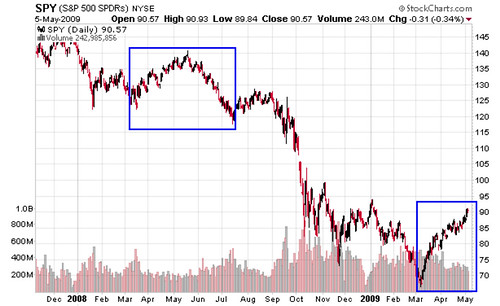 Thus, Spring of 2009 seems hauntingly familiar, except I hold no derivative positions. Sure enough, it charts similarly, as well. Increasing pricing on decreasing volume seems to be the portent of doom. (3/08-7/08, Thanksgiving 08-Feb 09). I am attempting to become a reformed speculator, but synthetically shorting crap like WYN @ 10 is so very, very tempting (-WYN HB, +WYN HV (protection), +WYN TB). We'll see if discipline prevails.
Prediction II: 401(k)/IRA redemptions and loans will be restricted. Over 5M Americans are unemployed and that's likely a conservative estimate. Moreover, many of the unemployed/underemployed have been so for months now. As the personal savings rate actually went negative during the bubble and the collective home equity piggy bank has been smashed, defined contribution funds are increasingly likely to be drained. Moreover, people are beginning to wise up to the fact that the 401(k) may well have been the greatest scam ever perpetuated by Wall Street, next to Donald Trump's hair. Thus, there has been a steady outflow of cash from equity mutual funds over the last year. If you compare the market capitalization of the NYSE to defined contribution plan/IRA equity assets, you'll discover the Evil Whose Name Can Never Be Spoken: Much of Wall Street is Main Street. While this topic could easily fill another 10 posts, if not an entire blog, let it suffice to say that DC plan redemptions en masse would cripple the stock market. Notice how Obama's campaign promise to ease penalties on 401(k) hardship redemptions has never been revisited. As the stock market goes, so does Wall Street, so this will not be allowed to happen
Prediction III: Municipalities will default in record numbers and won't get bailouts resembling what Wall Street received. Recently, I've been looking at the budgets of various local governments across the country. During the credit bubble, many ran deficits, not unlike their citizens. Unfortunately, municipalities generate revenue primarily through real estate tax, sales tax, and, less often, income tax, which are all falling at a significant rate. I expect that they'll attempt to issue more bonds, but at some point credit rating deterioration will induce unservicable rates. I don't expect significant federal assistance either, due to Wall Street's complete ownership of Congress and the Treasury. Instead, bankrupt cities will have privatization rammed down their throats, because little is more profitable than a monopoly on products with inelastic demand, like water and policing.
Prediction IV: Free markets will become even more farcical with consolidation. I don't think there is a company in existence that is interested in truly free trade. In practice, the phrase "free trade" has come to stand for using competition to decrease input costs, while attempting to reduce competitive forces affecting output prices. A developing nation's poverty will continue to be viewed as its greatest resource, to the detriment of American workers who insist on an "extravagant" standard of living. Wage and benefit claw backs will increase, while price fixing becomes even more blatant, as competing companies consolidate. In the last decade, we've seen little along the lines of anti-trust legislation or enforcement and I expect this to worsen. Within 5 years, I can envision the same style of collusion, demonstrated by the petroleum industry under Bush, to be adopted by producers of goods with low elasticity, like food, medicine, and energy.
Prediction V: This blog will not get any funnier. Truly humorous blogs are a rarity, while commonality is a staple here. Thus, never doubt my grave sincerity when I make proclamations like; the only asset class that is guaranteed to continually appreciate is Golden Girls memorabilia, which constitutes the basis for its use as a global currency standard. Really, I think I may have been mistaken for someone else.
So there you have it. In a year, I, hopefully, can look back at this post and say, "What a moron. I need to trade my computer in for an Etch-A-Sketch." In the mean time, I'll be working on my Canadian residency visa and hoarding Bea Arthur posters by the gross.
5/5/09
Fidelity Investment's Idea of Transparency
Apparently, it's acceptable to lie to potential investors so long as you tell them that you're lying.

 Remember the good old days, when the word guaranteed meant that an outcome was certain.

 Remember the good old days, when the word guaranteed meant that an outcome was certain.
Subscribe to:
Posts (Atom)

 Posts